


Saturday, May 29, 2021

Saturday, April 17, 2021
latest Covid-19 news
Coronavirus India Live Updates: Global death toll nears 3 million
Coronavirus (Covid-19) India Lockdown News Live Updates: There are now 16,79,740 active cases while 1,26,71,220 people have recovered from the disease.
 Covid-19 testing at Chacha Nehru Bal Chikitsalaya on Friday in New Delhi. (Express Photo By Amit Mehra)
Coronavirus India Live Updates: Amid a steep rise in coronavirus cases, the Congress’ top brass met virtually on Saturday and began deliberations on the steps needed to deal with the Covid-19 situation in the country.
The Congress Working Committee (CWC) meeting, chaired by Congress president Sonia Gandhi, was attended by former party chief Rahul Gandhi, general secretaries, other permanent invitees and state in-charges of the party. The CWC is discussing the current Covid-19 situation in the country and steps that need to be taken urgently to check the further spread of the virus.
India on Saturday reported 2,34,692 new Covid-19 cases and 1,341 deaths in the last 24 hours, according to data from the Union Health Ministry. The total cases in the country now stand at 1,45,26,609. There are now 16,79,740 active cases while 1,26,71,220 people have recovered from the disease. The overall death toll has reached 1,75,649. As many as 11,99,37,641 people have been vaccinated so far.
Meanwhile, the world’s Covid-19 death toll is approaching another grim milestone — nearly three million people have died from the virus since the first cases surfaced more than 14 months ago. The global death toll stands at 2,990,993, while the number of confirmed coronavirus cases has surged to nearly 140 million, according to a New York Times database, as countries race to provide enough vaccines to slow the relentless pace of infections. The pace of deaths has been accelerating. The world did not record one million deaths until Sept. 28, but had recorded two million by Feb. 21, less than five months later. And the latest million took less than two months. The United States, Brazil and Mexico lead the world in Covid-19 deaths.
Friday, March 26, 2021


Saturday, March 6, 2021

Saturday, February 27, 2021
HOW TO INSERT VALUES IN MS ACESS TABLE .
Full names Date of Birth gender Physical address Postal address Contact number Email Address
Leonard Hofstadter Male Woodcrest 0845738767
Sheldon Cooper Male Woodcrest 0976736763
Rajesh Koothrappali Male Fairview 0938867763
Leslie Winkle 14/02/1984 Male 0987636553
Howard Wolowitz 24/08/1981 Male South Park P.O. Box 4563 0987786553 lwolowitz@email.me
Let's INSERT data one by one. We will start with Leonard Hofstadter. We will treat the contact number as a numeric data type and not enclose the number in single quotes.
INSERT INTO `members` (`full_names`,`gender`,`physical_address`,`contact_number`) VALUES ('Leonard Hofstadter','Male','Woodcrest',0845738767);
https://www.google.com/url?sa=t&rct=j&q=&esrc=s&source=video&cd=&cad=rja&uact=8&ved=2ahUKEwi49qikhozvAhXFVisKHRQRC6gQuAIwAnoECAUQCQ&url=https%3A%2F%2Fwww.youtube.com%2Fwatch%3Fv%3D_pE7S-lzpa4&usg=AOvVaw1Hcr6ngFBmzHE0HkUiA1s7
Friday, February 26, 2021
CRETE TABLE IN MS ACCESS
MS ACCESS IS THE GREATE SOFTWARE TO MANAGE THE DATABASE IT HELP US IN THE MANAGMENT OF OUR DATA .
WE CAN EASILY MANAGE OUR DATA THROUGH MS ACCESS SOFTWARE,
SO TODAY WE LEARN THAT ,HOW WE CAN MAKE A TABLE IN MS ACCESS BY USING QUERY DESIGN OPTION IN MY SQL VIEW.
STEPS TO CREATE TABLE BY USING QUERY DESIGN OPTION * OPEN THE MS ACCESS OFFICE
*CLICK ON CREATE BLANK, WRITE THE NAME OF THE DATABASE AND CLICK ON CREATE
*A NEW BLANK DATABASE SHEET IS CREATED
*NOW,CLICK ON THE CREATE TAB OPTION
*THEN CLICK ON THE QUERY DESIGN OPTION IN OTHERS GROUP
* A DROPDOWN MENU WILL APPEAR, CLICK ON ADD AND THEN CLICK ON CLOSE OPTION WHICH WILL APPER IN BOTTOM
OF DROP DOWN MENU
* NOW CLICK ON THE VIEW MENU WHICH IS IN THE EXTREME LEFT SIDE OF THE WINDOW
*A NEW DIALOGBOX WILL APPEAR ,CHOOSE THE SQL VIEW OPTION
*A NEW SLIDE WILL APPEAR.
NOW HERE WE CAN WRITE A STATEMENT TO CREATE OUR TABLE ,
BUT BEFORE WRITING WE SHOULD NOW ABOUT THE FIELD NAME AND THERE DATA TYPE .
SO ,HERE IS THE IS THE LIST OF THE FIELD NAME WITH THERE DATA TYPE.
FIELD NAME = DATATYPE
Name = VARCHAR
Rollno = INT
phone = INTEGER
FOR EXAMPLE ..........
TABLE NAME STUDENT
Create Table Student
(
roll_number int not null primary key,
firstname varchar(20),
lastname varchar(30),
DOB date(DD/MM/YY),
fathername varchar(67),
mothername varchar(34),
class char(1),
phone integer(10),
address varchar(23),
email varchar(56)
)
NOW CLICK ON THE RUN! OPTION
THE TABLE IS CREATED.
THANKYOU.
latest science news
A dog buried at Berenice was protected with a piece of pottery.
M. Osypinska
Graves of nearly 600 cats and dogs in ancient Egypt may be world’s oldest pet cemetery
By David GrimmFeb. 26, 2021 , 10:45 AM
The cats and dogs lie as if asleep, in individual graves. Many wore collars or other adornments, and they had been cared for through injury and old age, like today’s pets. But the last person to bury a beloved animal companion in this arid Egyptian land on the coast of the Red Sea did so nearly 2000 years ago.
The site, located in the early Roman port of Berenice, was found 10 years ago, but its purpose was mysterious. Now, a detailed excavation has unearthed the burials of nearly 600 cats and dogs, along with the strongest evidence yet that these animals were treasured pets. That would make the site the oldest known pet cemetery, the authors argue, suggesting the modern concept of pets wasn’t alien to the ancient world.
“I’ve never encountered a cemetery like this,” says Michael MacKinnon, a zooarchaeologist at the University of Winnipeg who has studied the role of animals across the bygone Mediterranean but was not involved with the new work. “The idea of pets as part of the family is hard to get at in antiquity, but I think they were [family] here.”
SIGN UP FOR OUR DAILY NEWSLETTER
Get more great content like this delivered right to you!
Archaeozoologist Marta Osypinska and her colleagues at the Polish Academy of Sciences discovered the graveyard just outside the city walls, beneath a Roman trash dump, in 2011. The cemetery appears to have been used between the first and second centuries C.E., when Berenice was a bustling Roman port that traded ivory, fabrics, and other luxury goods from India, Arabia, and Europe.
In 2017, Osypinska’s team reported unearthing the remains of about 100 animals—mostly cats—which appear to have been cared for like pets. But the exact nature of the site wasn’t clear. Salima Ikram, an expert on ancient Egyptian animals at the American University in Cairo, said at the time that the bones might have been discarded rubbish.
Fieldwork being conducted at the Berenice pet cemetery
M. Osypinska
Osypinska and her colleagues have now excavated the remains of 585 animals from the site and analyzed the bones in detail. A veterinarian helped the team determine health, diet, and cause of death.
The animals appear to have been laid gently in well-prepared pits. Many were covered with textiles or pieces of pottery, “which formed a kind of sarcophagus,” Osypinska says. More than 90% were cats, many wearing iron collars or necklaces threaded with glass and shells. One feline was placed on the wing of a large bird.
The team found no evidence of mummification, sacrifice, or other ritual practices seen at ancient animal burial places such as the Ashkelon site in Israel. At Berenice, most of the animals appear to have died from injury or disease. Some cats have fractured legs or other breaks that may have been caused by falls or from being kicked by a horse. Others died young, possibly from infectious diseases that spread rapidly in the cramped city.
The dogs, which make up only about 5% of the burials (the rest are monkeys), tended to be older when they died. Many had lost most of their teeth or suffered periodontal disease and joint degeneration.
“We have individuals who have very limited mobility,” Osypinska says. Yet many lived long lives and their injuries healed. “Such animals had to be fed to survive,” she says, “sometimes with special foods in the case of the almost-toothless animals.”
A cat from Berenice was wearing a bronze collar.
P. Osypinska
The fact that humans took such good care of the animals, especially in a rough-and-tumble region where almost all resources had to be imported—and that they took such care in burying them, just as many modern owners do—suggests the people of Berenice had a strong emotional bond with their cats and dogs, the team concluded last month in World Archaeology. “They weren’t doing it for the gods or for any utilitarian benefit,” Osypinska says. Instead, she argues that the relationship between people and their pets was “surprisingly close” to the one we see today.
Ikram is convinced. “This is a cemetery,” she says. “And it sheds an interesting light on the inhabitants of Berenice and their relationships with their animals.”
Archaeologist Wim Van Neer is also on board. “I’ve never seen a cat with a collar” from so long ago, says Van Neer, of the Royal Belgian Institute of Natural Sciences, who has studied the relationship between people and animals in the ancient world, including at Berenice.
Still, he says it’s possible the people of Berenice valued their cats and dogs for nonsentimental reasons. A seaport would have teemed with rats, he notes, making cats a prized working animal. And although a few of the pups at the site were small dogs akin to today’s toy breeds—and thus likely had little utility except as lap dogs—larger canines could have guarded homes and consumed refuse. “I don’t believe it was just a loving relationship.”
Osypinska hopes the new work will convince other archaeologists that companion animals are worth study. “At first, some very experienced archaeologists discouraged me from this research,” arguing the pets were irrelevant for understanding the lives of ancient peoples, she says. “I hope the results of our studies prove that it’s worth it."sherryamrohi.com"
Friday, February 19, 2021
ALL ABOUT ISSAC NEWTON
Sir Isaac Newton PRS (25 December 1642 – 20 March 1726/27[a]) was an English mathematician, physicist, astronomer, theologian, and author (described in his time as a "natural philosopher") who is widely recognised as one of the most influential scientists of all time and as a key figure in the scientific revolution. His book Philosophiæ Naturalis Principia Mathematica (Mathematical Principles of Natural Philosophy), first published in 1687, established classical mechanics. Newton also made seminal contributions to optics, and shares credit with Gottfried Wilhelm Leibniz for developing the infinitesimal calculus.
In Principia, Newton formulated the laws of motion and universal gravitation that formed the dominant scientific viewpoint until it was superseded by the theory of relativity. Newton used his mathematical description of gravity to derive Kepler's laws of planetary motion, account for tides, the trajectories of comets, the precession of the equinoxes and other phenomena, eradicating doubt about the Solar System's heliocentricity. He demonstrated that the motion of objects on Earth and celestial bodies could be accounted for by the same principles. Newton's inference that the Earth is an oblate spheroid was later confirmed by the geodetic measurements of Maupertuis, La Condamine, and others, convincing most European scientists of the superiority of Newtonian mechanics over earlier systems.
Newton built the first practical reflecting telescope and developed a sophisticated theory of colour based on the observation that a prism separates white light into the colours of the visible spectrum. His work on light was collected in his highly influential book Opticks, published in 1704. He also formulated an empirical law of cooling, made the first theoretical calculation of the speed of sound, and introduced the notion of a Newtonian fluid. In addition to his work on calculus, as a mathematician Newton contributed to the study of power series, generalised the binomial theorem to non-integer exponents, developed a method for approximating the roots of a function, and classified most of the cubic plane curves.
Newton was a fellow of Trinity College and the second Lucasian Professor of Mathematics at the University of Cambridge. He was a devout but unorthodox Christian who privately rejected the doctrine of the Trinity. Unusually for a member of the Cambridge faculty of the day, he refused to take holy orders in the Church of England. Beyond his work on the mathematical sciences, Newton dedicated much of his time to the study of alchemy and biblical chronology, but most of his work in those areas remained unpublished until long after his death. Politically and personally tied to the Whig party, Newton served two brief terms as Member of Parliament for the University of Cambridge, in 1689–90 and 1701–02. He was knighted by Queen Anne in 1705 and spent the last three decades of his life in London, serving as Warden (1696–1699) and Master (1699–1727) of the Royal Mint, as well as president of the Royal Society (1703–1727).
Wednesday, January 27, 2021
How do Search Engine Work.
How do search engines work?
Search engines work by taking a list of known URLs, which then go to the scheduler. The scheduler decides when to crawl each URL. Crawled pages then go to the parser where vital information is extracted and indexed. Parsed links go to the scheduler, which prioritizes their crawling and re-crawling.
When you search for something, search engines return matching pages, and algorithms rank them by relevance.
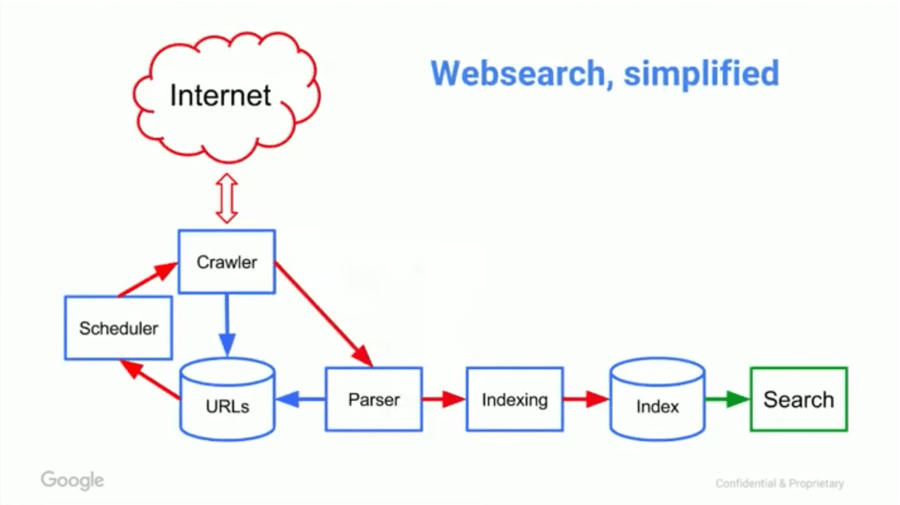
We’ll cover ranking algorithms shortly. First, let’s drill deeper into the mechanisms used to build and maintain a web index to make sure we understand how they work. These are scheduling, crawling, parsing, and indexing.
Sidenote.
This
process only applies to web search engines like Google, Bing, and
DuckDuckGo. There are other types of search engines like Amazon,
YouTube, and Wikipedia that only show results from their website. Scheduling
The scheduler assesses the relative importance of new and known URLs. It then decides when to crawl new URLs and how often to re-crawl known URLs.
Crawling
The crawler is a computer program that downloads web pages. Search engines discover new content by regularly re-crawling known pages where new links often get added over time.
For example, every time we publish a new blog post, it gets pushed to the top of our blog homepage, where there’s a link.
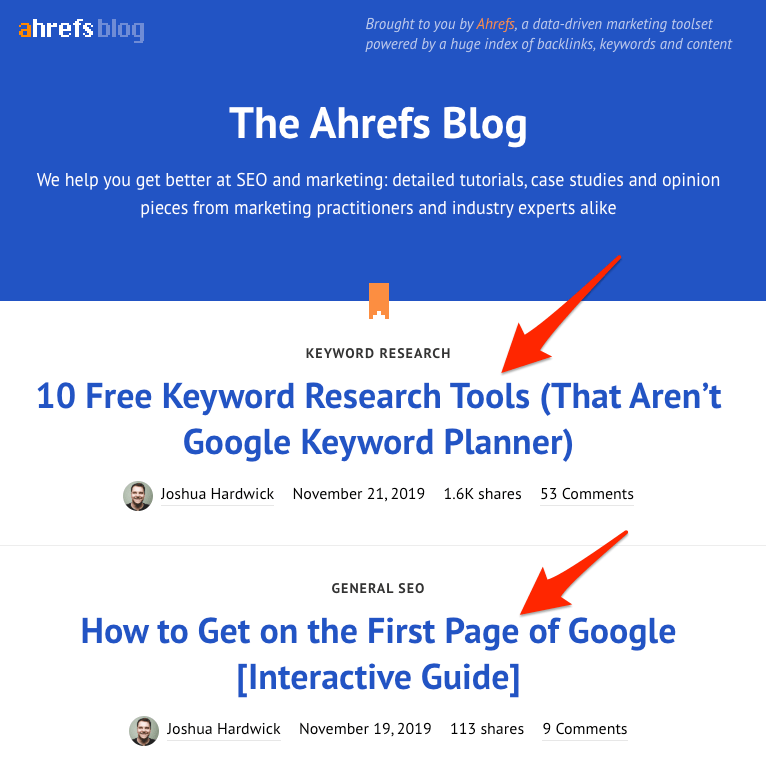
Showing links to our latest blog posts on the Ahrefs Blog homepage.
When a search engine like Google re-crawls that page, it downloads the content of the page with the recently-added links.
The crawler then passes the downloaded web page to the parser.
Sidenote.
Crawling doesn’t involve “following” links from page to page, as many people believe. Parsing
The parser extracts links from the page, along with other key information. It then sends extracted URLs to the scheduler and extracted data for indexing.
Indexing
Indexing is where parsed information from crawled pages gets added to a database called a search index.
Think of this as a digital library of information about trillions of web pages.
Wednesday, January 20, 2021
About SEO(Search Engine Otimization)
What is SEO?
SEO stands for Search Engine Optimization, which is the practice of increasing the quantity and quality of traffic to your website through organic search engine results.
What goes into SEO?
To understand the true meaning of SEO, let's break that definition down and look at the parts:
- Quality of traffic. You can attract all the visitors in the world, but if they're coming to your site because Google tells them you're a resource for Apple computers when really you're a farmer selling apples, that is not quality traffic. Instead you want to attract visitors who are genuinely interested in products that you offer.
- Quantity of traffic. Once you have the right people clicking through from those search engine results pages (SERPs), more traffic is better.
- Organic results. Ads make up a significant portion of many SERPs. Organic traffic is any traffic that you don't have to pay for.
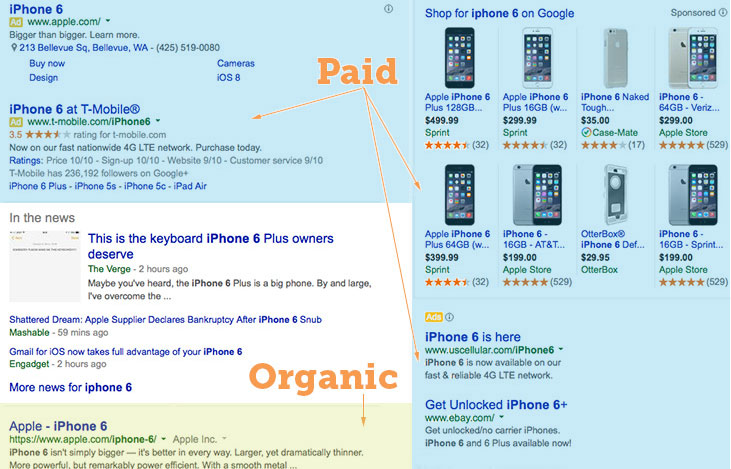
Organic search traffic is specifically any unpaid traffic that comes from SERPs.
How SEO works
You might think of a search engine as a website you visit to type (or speak) a question into a box and Google, Yahoo!, Bing, or whatever search engine you're using magically replies with a long list of links to webpages that could potentially answer your question.
That's true. But have you ever stopped to consider what's behind those magical lists of links?
Here's how it works: Google (or any search engine you're using) has a crawler that goes out and gathers information about all the content they can find on the Internet. The crawlers bring all those 1s and 0s back to the search engine to build an index. That index is then fed through an algorithm that tries to match all that data with your query.
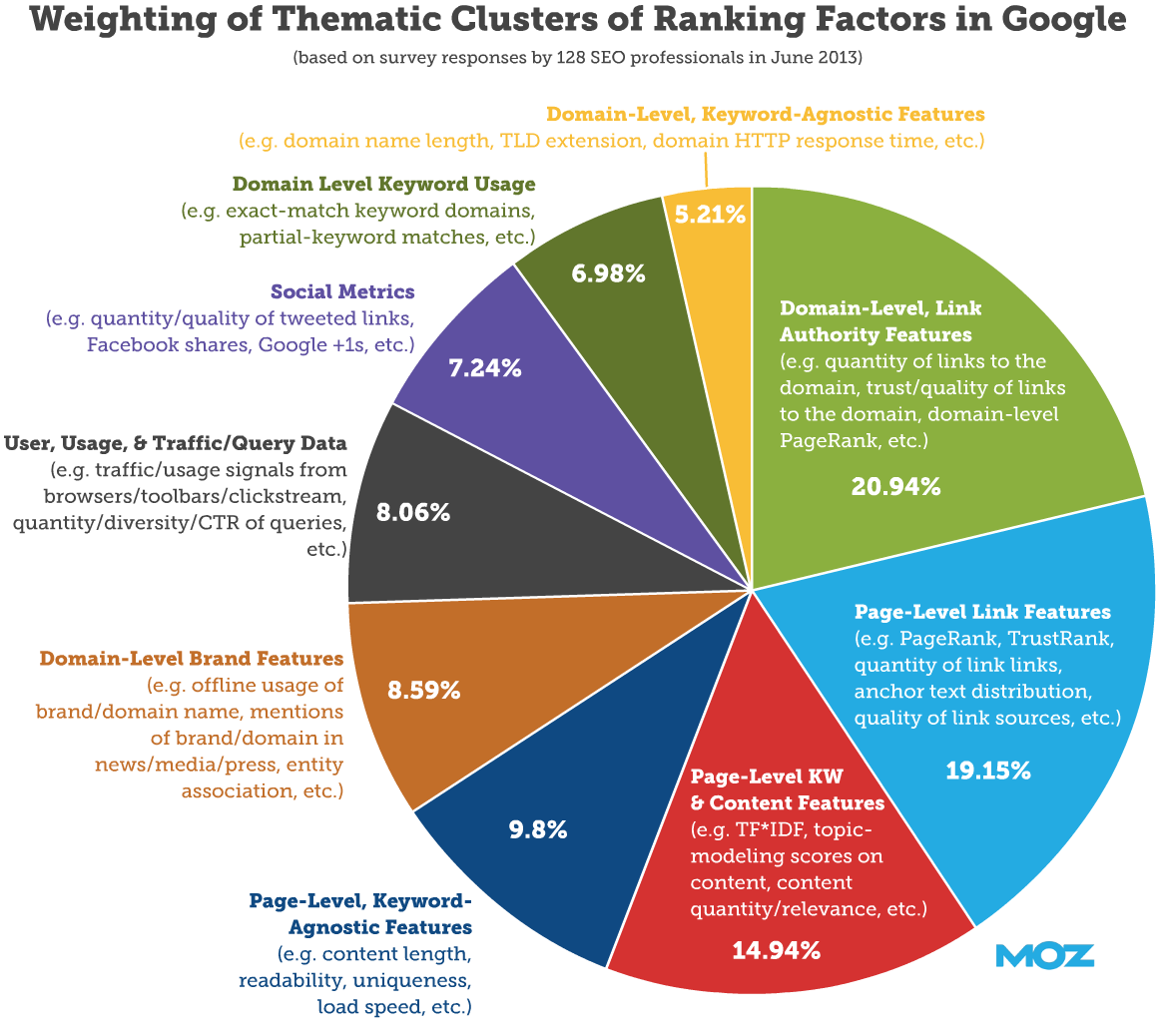
There are a lot of factors that go into a search engine's algorithm, and here's how a group of experts ranked their importance:
Wednesday, January 13, 2021
Did YOU know?
Did YOU Know?

The Eiffel Tower was built by GUSTAVE EIFFEL for the 1889 exposition universelle to celebrate the centennial anniversary of the french revolution.
 Its construction in two years ,two months,and five days was a technical and architectural achievement.
 Untial the completion of the Chrysler Building in New York,1930,the Eiffel Tower was the world tallest building.
 THE oldest imitation of the Eiffel Tower is Blackpool Tower in Lancashire[England].
Subscribe to:
Posts (Atom)
-
SOME INTRESTING FACT'S
-
What is SEO? SEO stands for Search Engine Optimization , which is the practice of increasing the quantity and quality of traffic to your...
-
How do search engines work? Search engines work by taking a list of known URLs, which then go to the scheduler . The scheduler decides wh...

